记于 2026 年 11 月 17 日夜。第一场常真味九瓶,第二场 Whale Club 六瓶,其中 Cornas 1990 magnum 一瓶跨两场,全晚共十四瓶。品评均为当晚原话与当场记录;Leroy Bourgogne 2004、Roumier Les Cras 2017 与 Kei Shiogai Pommard “Poisot” 2023 当晚只揭晓酒款,未留品评,此处只记酒款与背景。Le Massif 年份为 2023(酒标 lot RMS23)。常真味一段据 OpenRice、明报食评与《东周刊》2026 年 8 月报道核对,招牌菜为公开食评之作,非当晚菜单记录;Whale Club 一段据其地图页资料与当晚原话,两家俱乐部的比较为个人看法。照片均为当晚所拍原图,本版全幅呈现,未裁切。
东风
二〇二六年十一月十七日夜
Tuesday · 17 November 2026 · Evening · Hong Kong
A Wine Diary
Fourteen bottles in one evening, across two sittings, from 1962 to 2023 — sixty-one years. The first table was set at Chang Zhen Wei in Causeway Bay: grower Champagne to open, two whites in astonishing condition at the centre, and two blind flights to close. Then the party moved on to Whale Club in Central for six more — one of them the Cornas magnum, carried over from the first sitting. The wines will be finished and gone; the condition they were in, and the people around the table, are what I want to keep.
Fourteenbottles, two sittings
1962–2023sixty-one years
Twosittings · Chang Zhen Wei · Whale Club
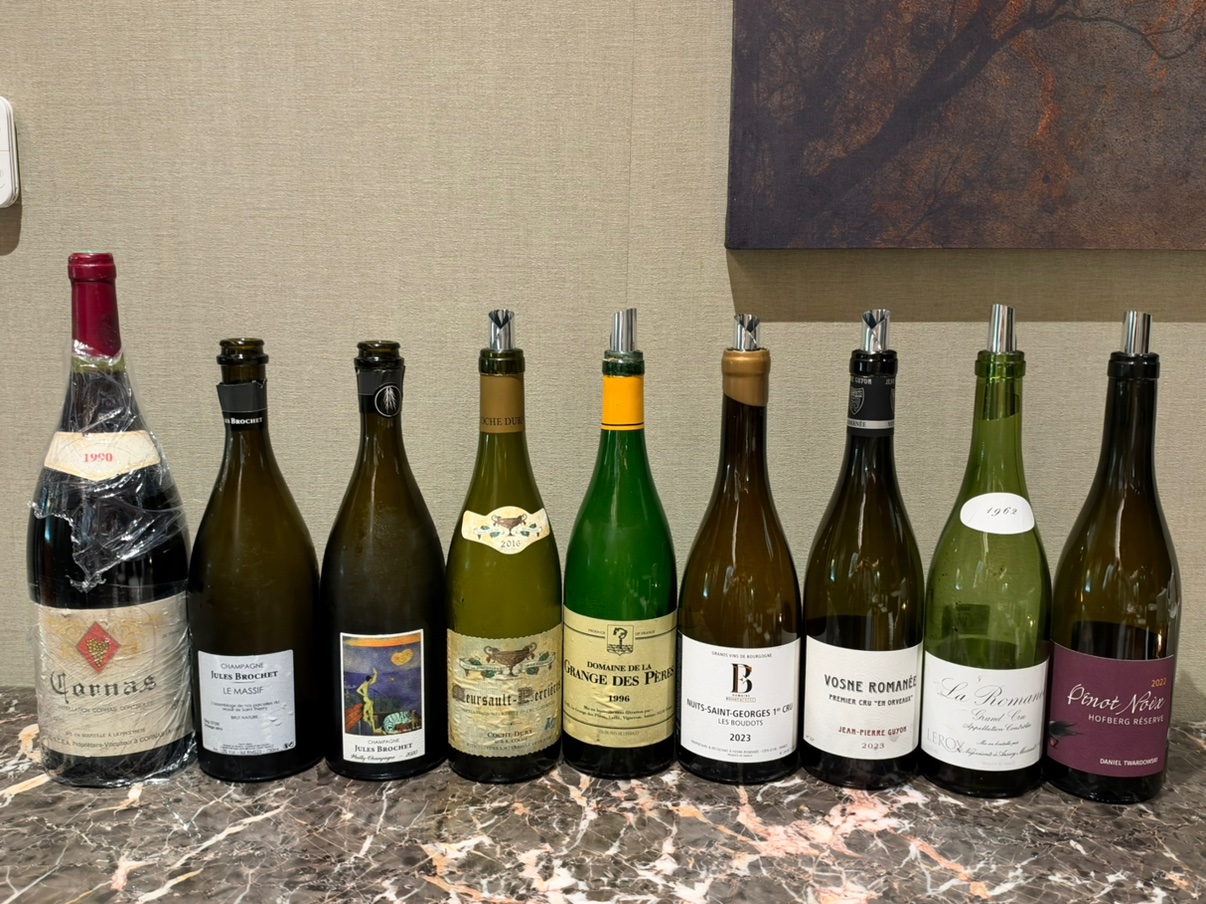
The first sitting's nine bottles, the original photograph shown in full — from the Cornas on the far left to the Twardowski on the far right, nothing cropped away.
The first sitting, from left to right: Cornas 1990; the two Jules Brochet Champagnes; Coche-Dury 2016; Grange des Pères 1996; the two 2023 Burgundies; the 1962 La Romanée; and Twardowski 2022. The order of the bottles is not the order of drinking — what follows is written bottle by bottle, in the order they were poured; the six bottles of the second sitting are recorded further on.
I
Champagne to Open — the Texture of Great White Wine
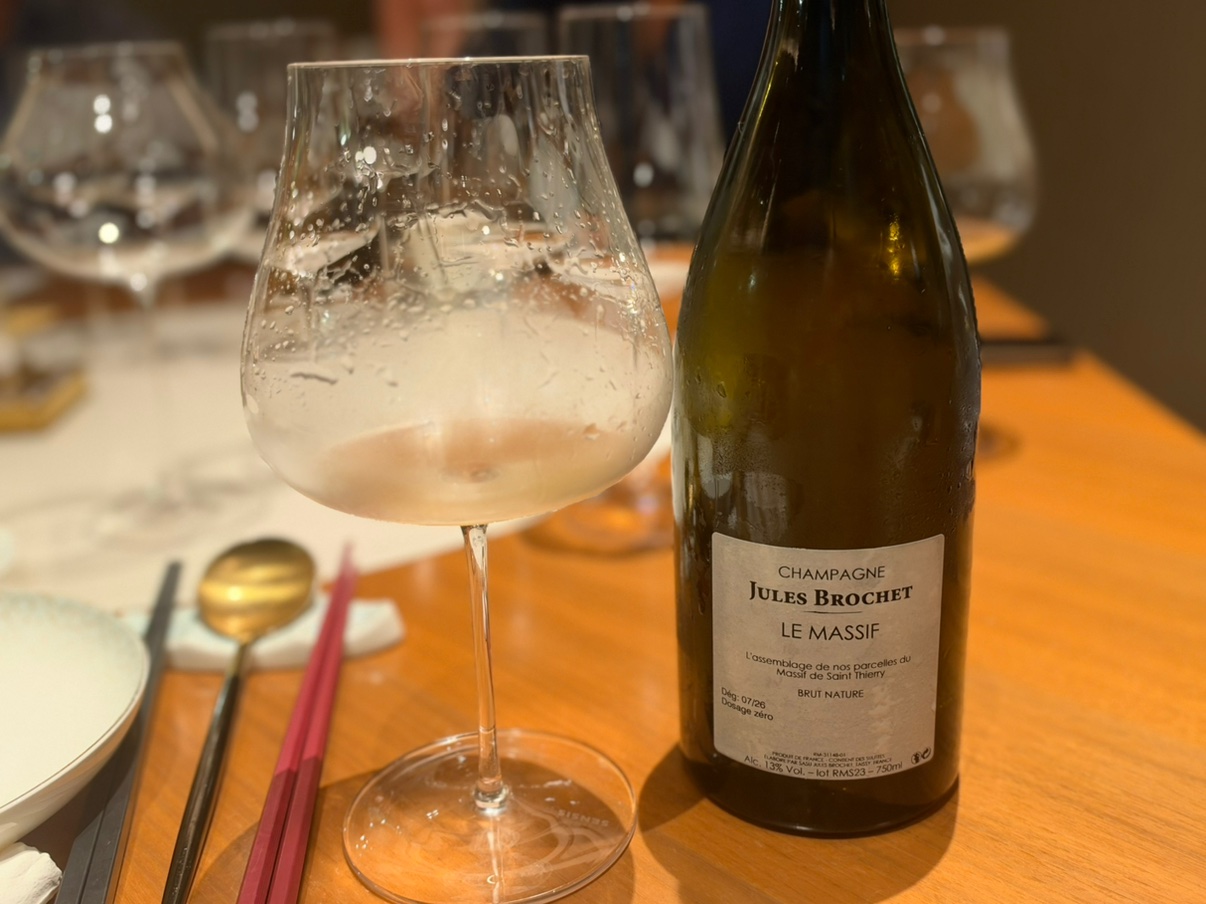
Le Massif, front label in close-up: Brut Nature, zero dosage. The lot RMS23 on the label is the 2023 base wine.
The First Bottle · Le Massif 2023
The evening opened on a Champagne theme. The first bottle stopped me with its aroma before anything else — not the usual flowers and fruit of Champagne, but a reductive note of toasted sesame.
Le Massif comes from the small grower estate Jules Brochet: Chardonnay from plots around the Massif de Saint-Thierry, from fifty-year-old vines. Only 300 bottles are made each year, and the secondary market has already taken it to EUR 1,000 a bottle. At that volume and that price, it is no longer simply a Champagne — it is a collector's piece.
My judgement on the night: the aroma sits very close to the d'Auvenay whites — that reductive sesame character of Lalou Bize-Leroy's Domaine d'Auvenay, which almost never appears in Champagne. In the mouth it felt even less like Champagne: dense in texture, steady at its core, with a mouthfeel approaching a great white wine, the bubbles reduced to an accent. For a zero-dosage Brut Nature to avoid leanness and sharpness, everything rests on old vines and a late harvest.
This bottle set the tone for the whole evening: we were not drinking for occasion, but for condition.
The Maker
Pierric Brochet
A rising name of the new generation, born in 1990
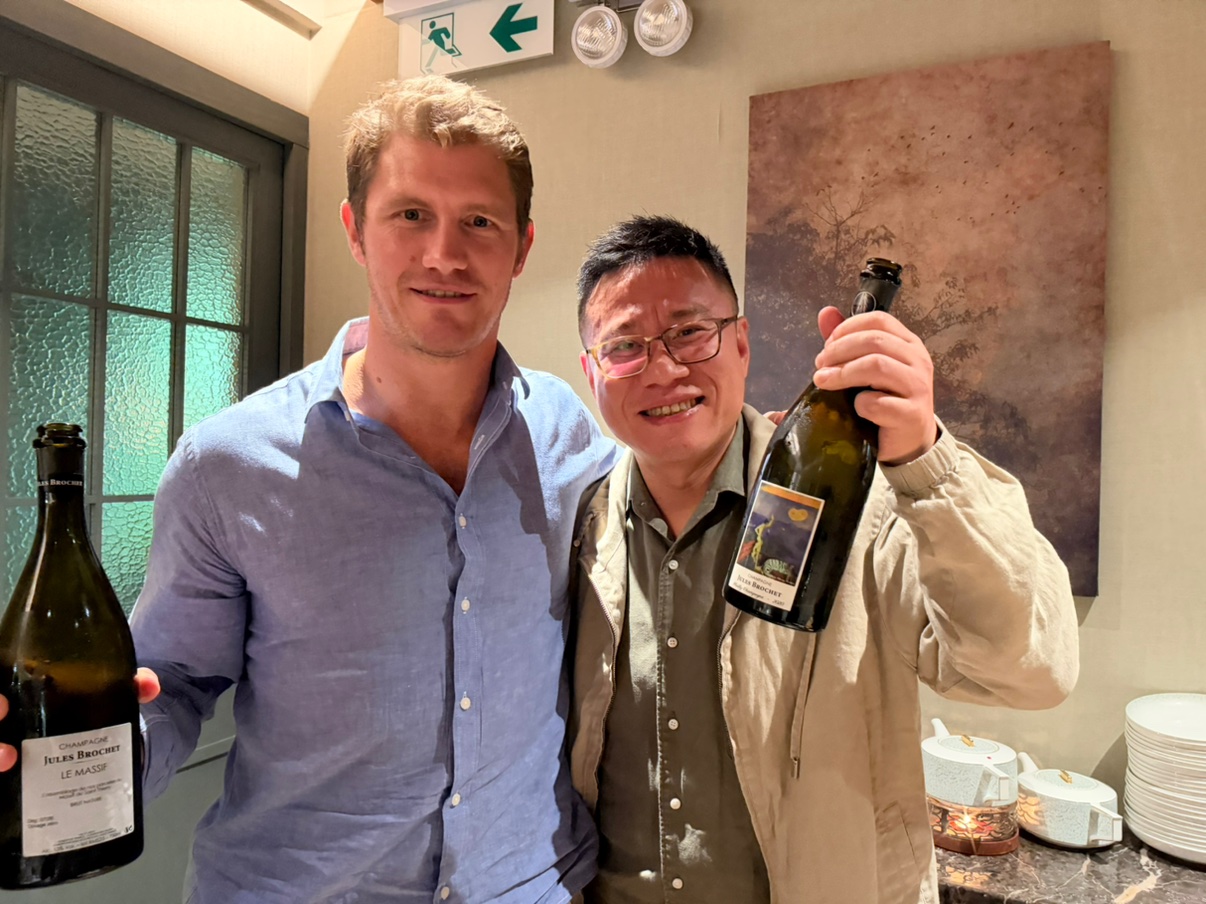
The man who made the evening's two Champagnes was sitting at the table. Pierric Brochet, born in 1990 — strikingly young among Champagne proprietors, and already one of the most closely watched names of the new grower generation.
His roots run deep in old Champagne. The estate stands at Taissy, at the foot of the Montagne de Reims, and he founded it in 2015 under the name Domaine Jules Brochet — Jules was his great-grandfather. The first wines were released only in 2019; within a few years, Le Massif was already a cuvée of 300 bottles a year at EUR 1,000 on the secondary market. His cousin is Gaspard Brochet, another grower whose name is rising fast — the young Brochets are writing their family back onto the map of Champagne.
Trained at Selosse — a Lineage That Says Everything
His training says even more. After agricultural school at Avize, in 2009 he went to intern in the cellars of Jacques Selosse — the sanctuary of grower Champagne, where Anselme Selosse became the godfather of an entire generation of terroir Champagne. Everyone who comes out of Selosse carries the same conviction in their blood: Champagne is a wine first, and bubbles second.
His Method: a Burgundian Way of Making Champagne
His vineyards cover some three and a half to four and a half hectares, scattered across Taissy, Mailly, Aÿ, Rilly-la-Montagne and Barzy, and have been farmed organically since 2020. The winemaking transplants Burgundy into Champagne, almost piece by piece: a late harvest, waiting for true ripeness; natural fermentation in 228-litre barrels; no filtration and no fining; sulphur kept to a minimum; and dosage at zero, or next to it.
“Champagne is a wine first, and bubbles second.”
It is a slow, risky, low-yield way of working, and what it buys is exactly what was in our glasses that night: a Chardonnay with the density of a great white wine, and a Pinot Noir deep enough to pour golden. Among the winemakers of his generation, he is one of the very few who have made the “new school” taste like a classic.
To drink a man's wines with the man himself at the table — the provenance of every bottle needed no research; we only had to look up and ask. An evening like that deserves a page of its own.
With the winemaker at Chang Zhen Wei, the full frame uncropped: he holds Le Massif; I hold the Mailly Pinot Noir. When the maker stands in front of you, the wine gains a history.
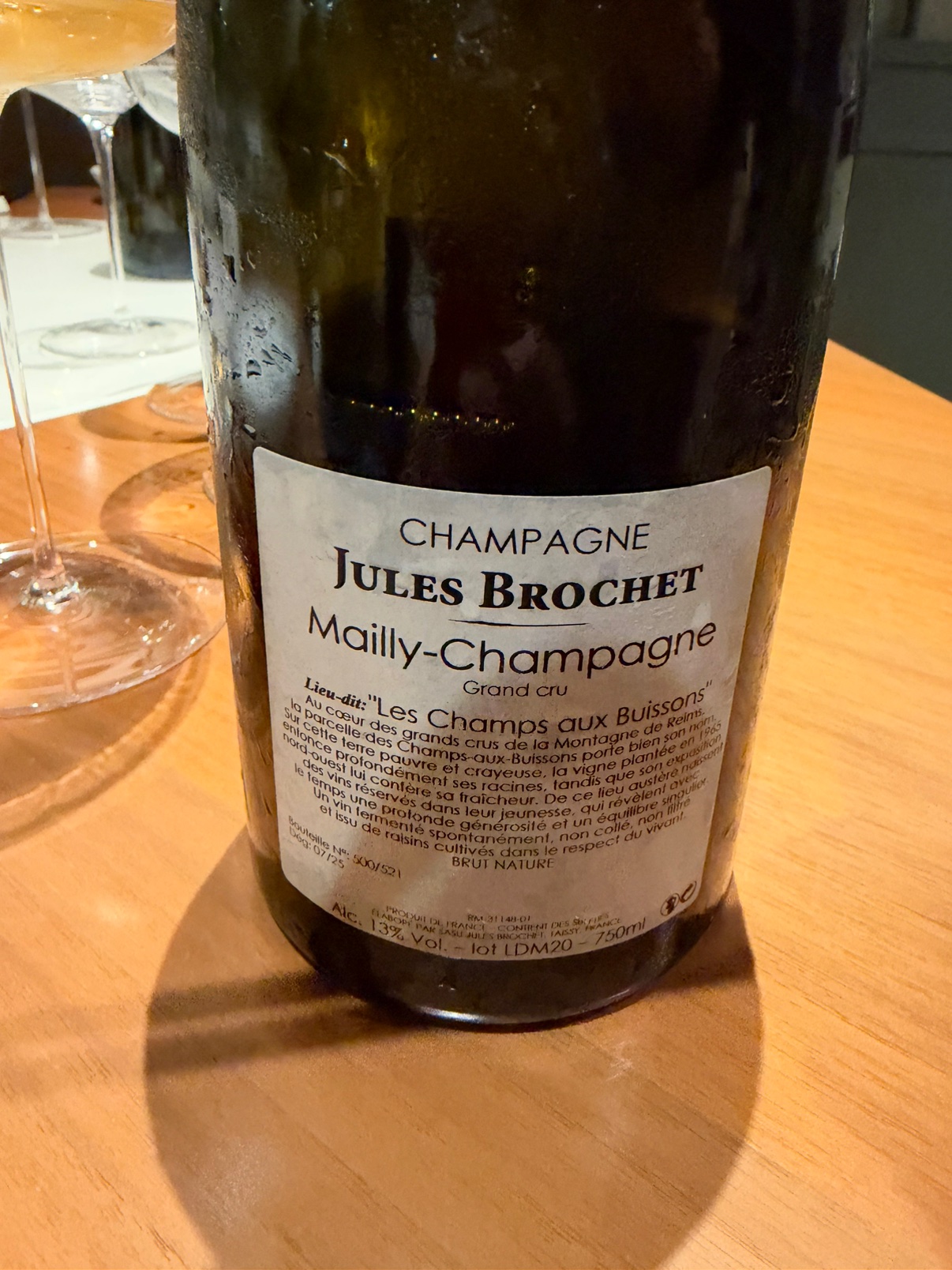
Jules Brochet · Mailly-Champagne Grand Cru 2020 · Pinot Noir · Les Champs aux Buissons
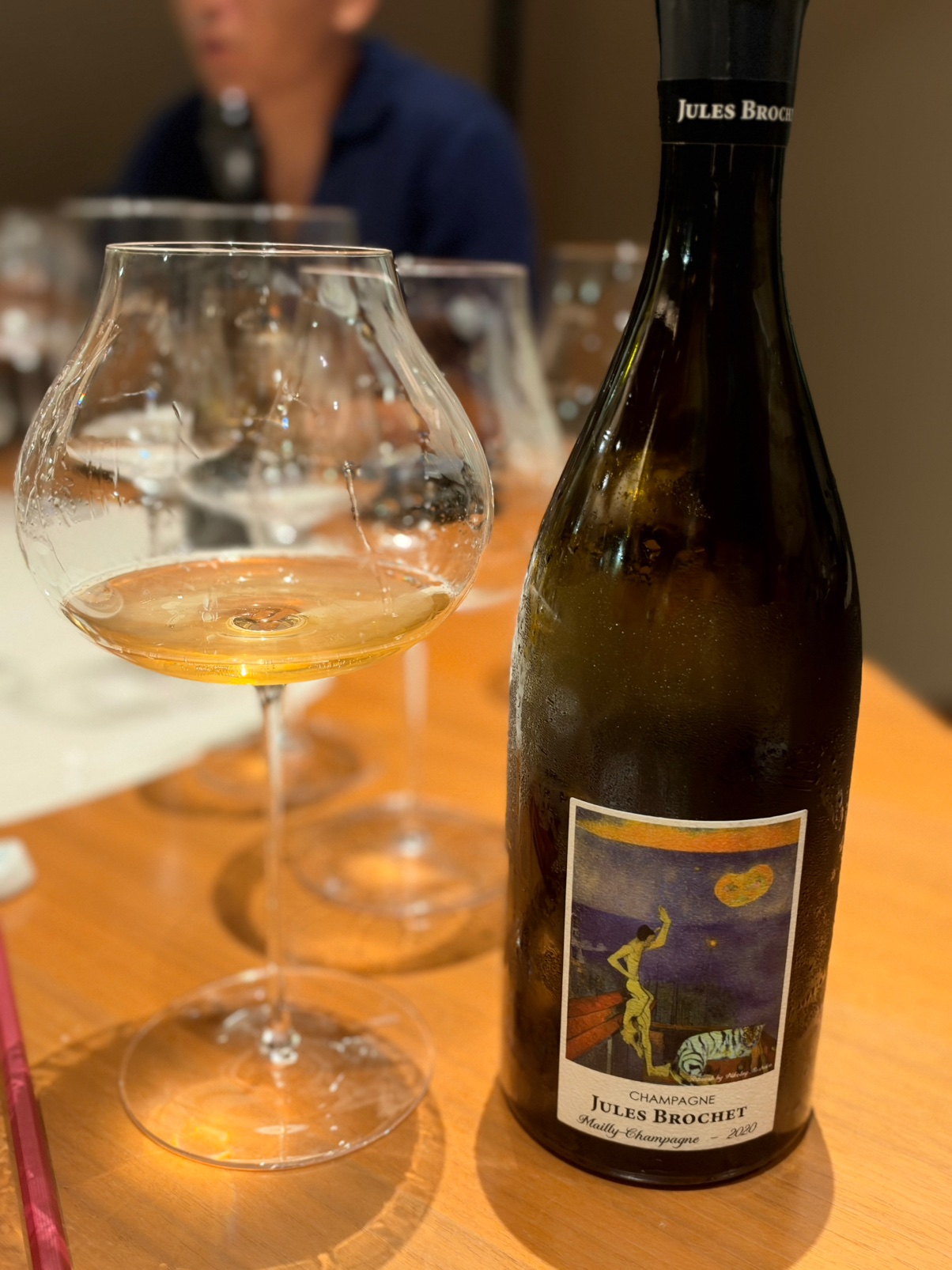
The second bottle turns to a red grape: Pinot Noir from the grand cru village of Mailly, already golden in the glass.The back label, shown in full: the lieu-dit Les Champs aux Buissons, and bottle number 500/521, clearly legible. The back label tells its own story: vines planted in 1965, poor chalk soils, natural fermentation, no filtration, no fining. Only 521 bottles were filled — and mine was number 500.
The Second Bottle · Mailly Pinot Noir 2020
One grower, two faces: after the white grape came the red. The fruit is from Mailly, a grand cru village — the lieu-dit Les Champs aux Buissons, Pinot Noir vines planted in 1965. The 2020 vintage rested on its lees for nearly five years and was disgorged only in July 2025.
“This bottle was superb — the acidity perfectly judged, and the yeast character in full.”
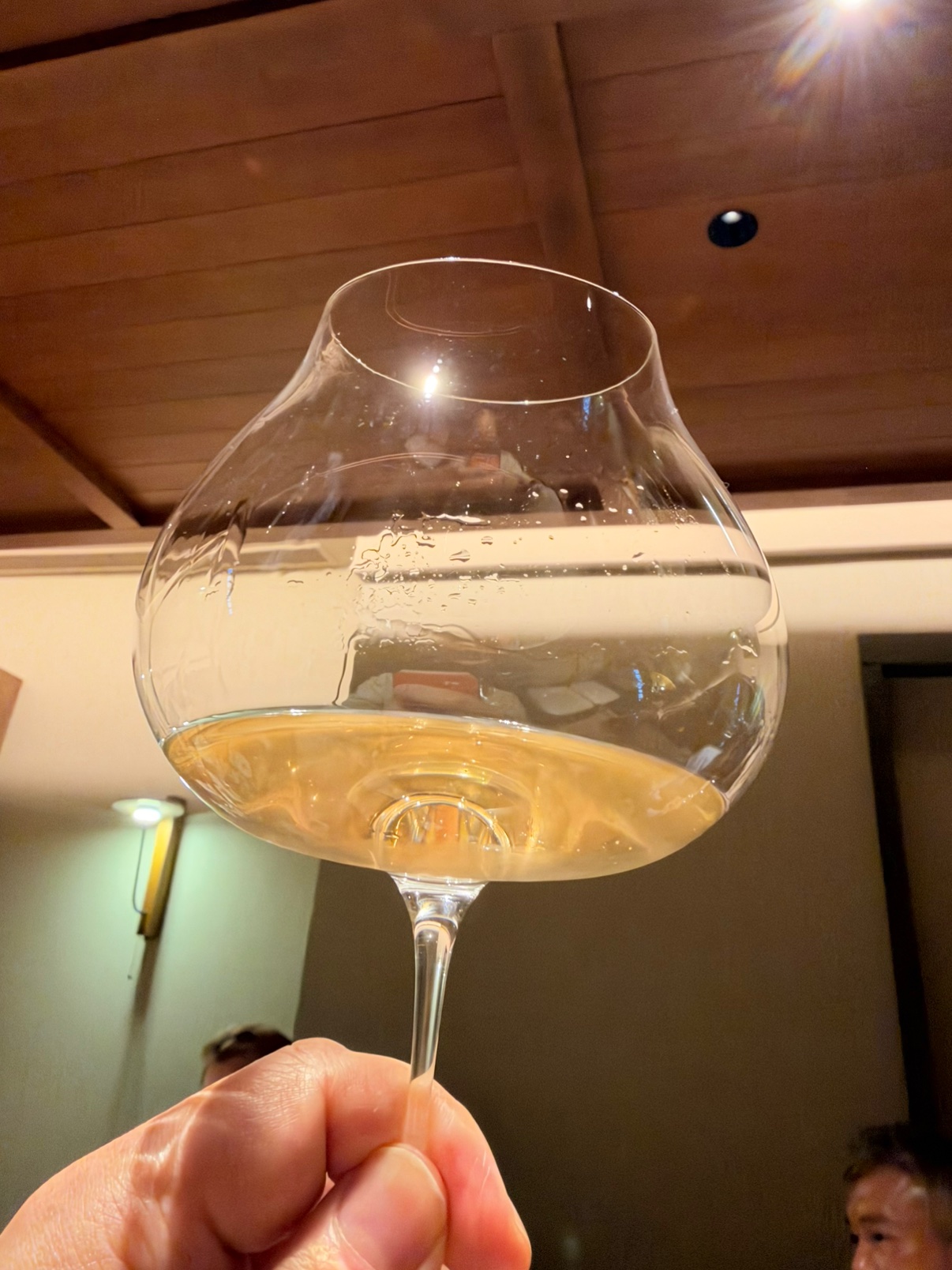
Those were my words on the night. The richness of yeast is what five years on lees buys; the acidity, balanced and never pushy, is what old vines on chalk deliver. Most striking of all was the colour: poured into the glass it was a deep, settled gold — not the pale gold of a young Champagne, but the gold of age and substance.
One estate, two bottles: a Chardonnay like a great white wine, a Pinot Noir with the frame of a red. By the end of this chapter, the Champagne theme had been drunk in full.
Raised to the light, the full frame uncropped — the four words I wrote down that night: a deep golden colour. Old-vine Pinot Noir, nearly five years on lees, and no filtration: this is where such a colour comes from. One look is enough to know this is no lightweight glass.
II
Two Whites — Time on Their Side
Grange des Pères · Coche-Dury
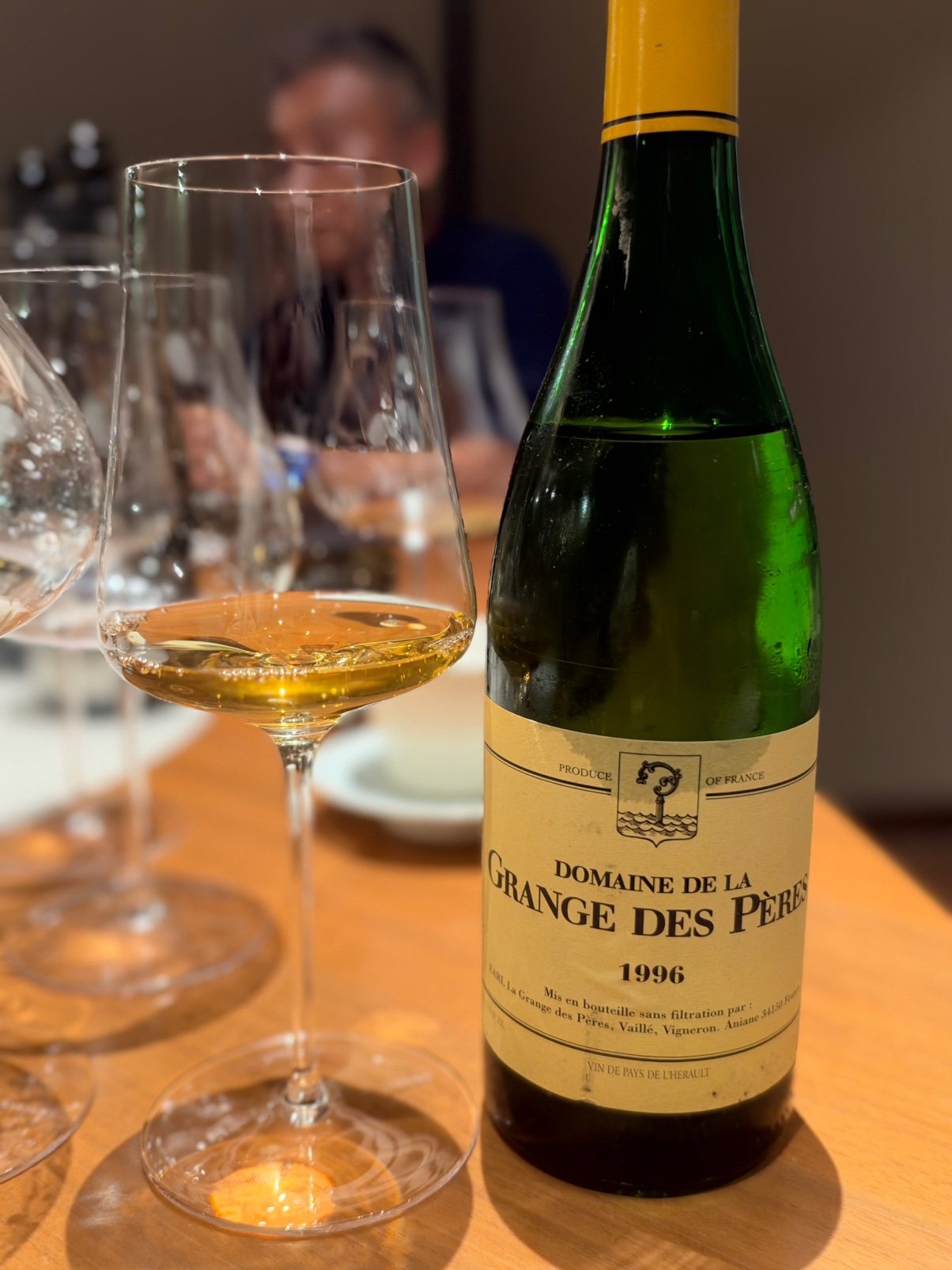
Domaine de la Grange des Pères · Blanc 1996 · Aniane, Languedoc
Grange des Pères Blanc 1996 — the label in close-up, the wine bright gold in the glass.
The Third Bottle · Grange des Pères Blanc 1996
“No oxidation at all. At its peak. Superb.”
At first glance this bottle is easy to misplace: it is blended in the Rhône's white idiom, yet it comes from Aniane in the Languedoc — Roussanne in the lead, Marsanne beside it, and a measure of Chardonnay. The aromatics were powerful; a very niche wine, and a very good drink.
From 1996 to today is a full thirty years. A white wine at thirty lives in fear of oxidation; this one showed none at all, and stood squarely at its peak. Its maker, Laurent Vaillé, trained under three masters — Coche-Dury, Chave and Trévallon. The white vineyard is under a hectare and yields some 1,200 bottles a year; the estate is known as the “Romanée-Conti of the South.” Thirty years without falling over is the wine's own constitution, and also the keeper's care. With this glass, I knew the pattern of the night: every bottle had been chosen for its condition.
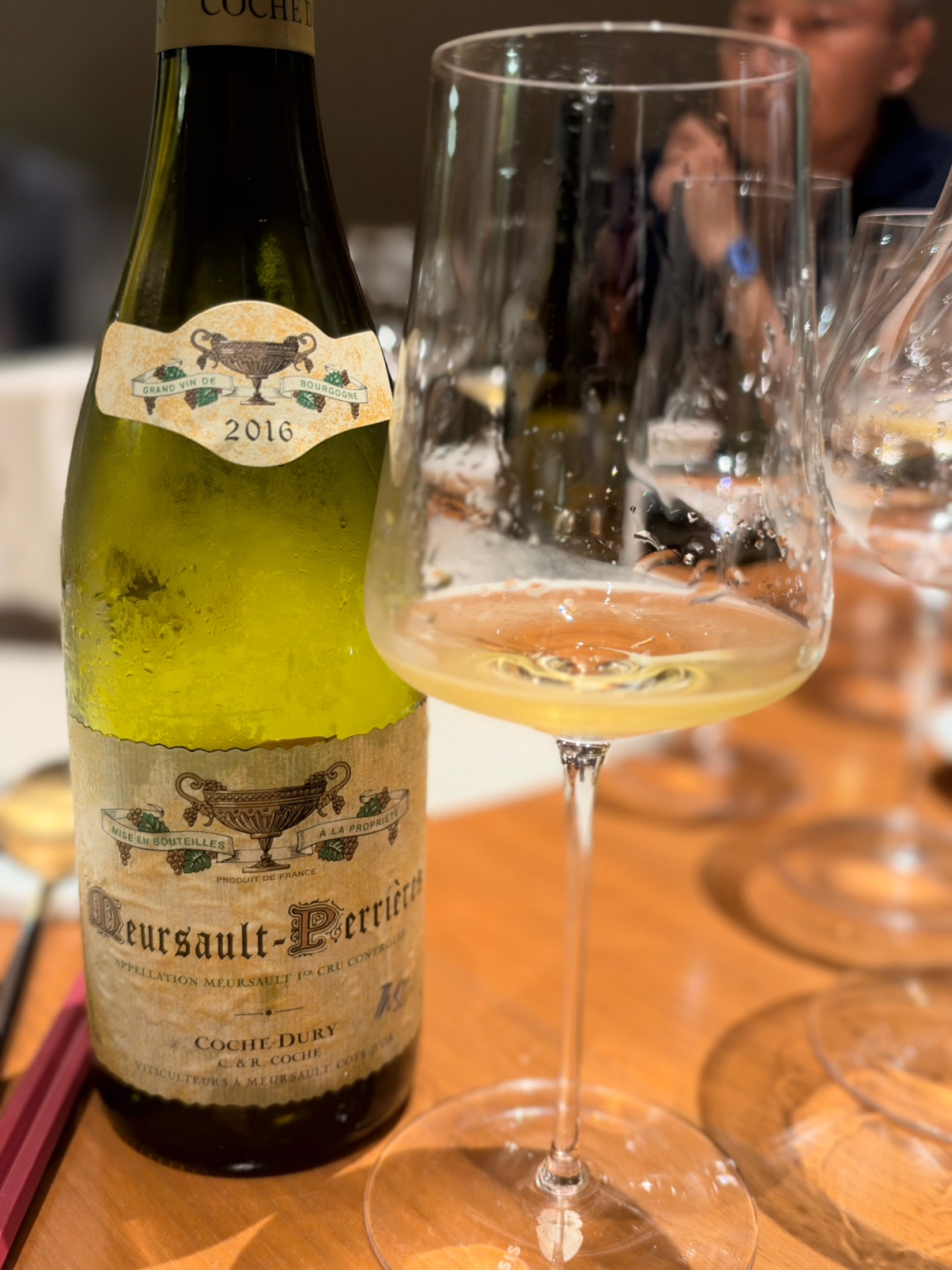
The great gold cup: Coche-Dury, Meursault-Perrières 2016 — the label in close-up, full frame.
The Fourth Bottle · Coche-Dury Perrières 2016
This one hardly needs an introduction from me — the great gold cup, an internet-famous bottle from the finest vineyard in Meursault. Perrières is the king of Meursault's premiers crus; its very name comes from stone.
“A gloriously opulent Chardonnay, full of flinty minerality.”
The opulence is Meursault's foundation; the flint is the spine of Perrières. It enters rich and ample, then the minerality spreads across the tongue, and the finish is clean. This bottle had both, in full.
One coincidence is worth recording: Laurent Vaillé of Grange des Pères, the previous bottle, spent his apprenticeship at Coche-Dury learning to make wine. Master and apprentice, opened one after the other at the same table on the same night — no amount of planning arranges a line-up like that.
III
Two 2023s — Two Characters of Young Burgundy
Boigey · Guyon
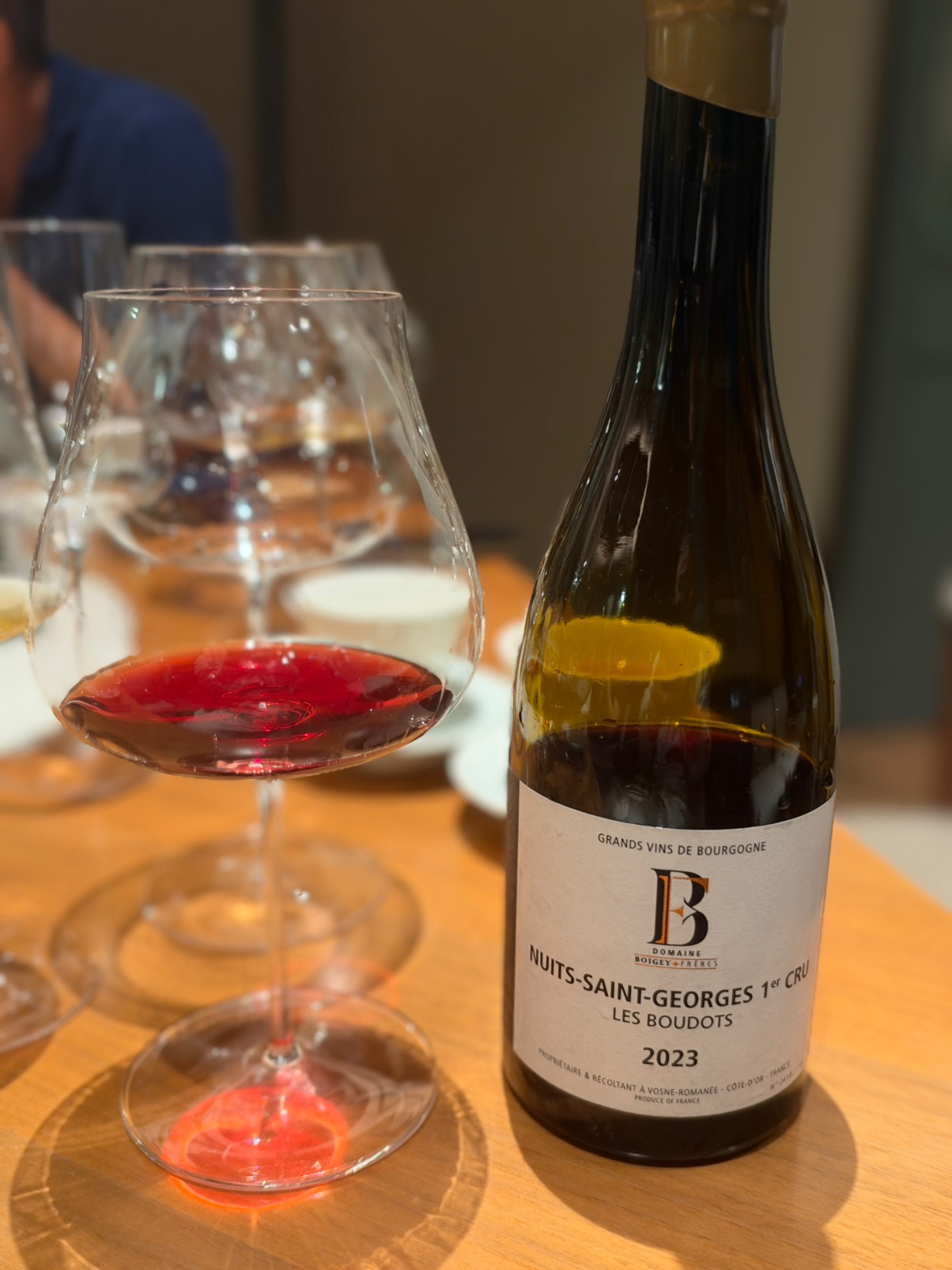
Boigey Frères · Les Boudots 2023 · The First Red
The first red of the night: Boigey Les Boudots 2023, in close-up.
The Fifth Bottle · Boigey Les Boudots 2023
The Boigey brothers are a rising small estate in Vosne-Romanée: the family vineyards were rented out for nearly fifty years, taken back in 2017, and their first vintage was 2019. Les Boudots sits at the northern edge of Nuits-Saint-Georges, against Vosne's Malconsorts — the most Vosne-like vineyard in Nuits.
“Easy to drink, and relatively simple in its layers.”
That was my verdict, in one direct line. Unpacked, its fruit comes in three layers: red fruit in front — red cherry and raspberry at their brightest, and I confirmed it on the night, red fruit led; black cherry and blackberry behind, giving it the frame of Nuits-Saint-Georges; and florals rising above it all. What we drank was primary fruit and flowers — clean, supple, its complexity not yet grown. Boudots needs a few more years for its layers to unfold. As the first red of the night, being easy to drink was precisely its job.
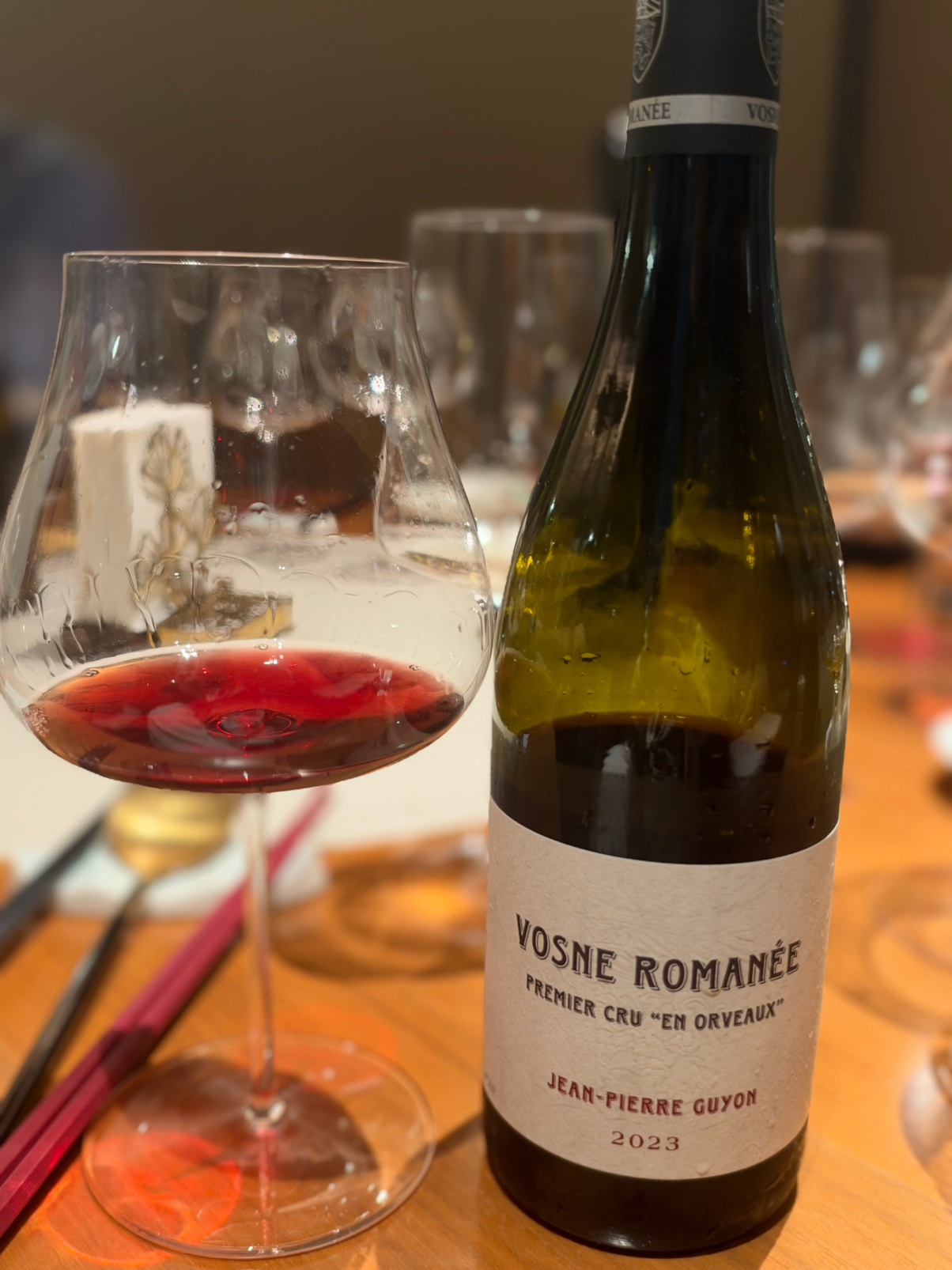
Jean-Pierre Guyon · Vosne-Romanée 1er Cru En Orveaux 2023
Guyon's En Orveaux 2023 — the label in close-up, full frame.
The Sixth Bottle · Guyon En Orveaux 2023
En Orveaux is the northernmost and coldest premier cru in Vosne-Romanée — 1.8 hectares in all, and often the last vineyard in the village to be picked. Guyon holds just 0.13 hectares of seventy-year-old vines there. His signature is the “cloud sorting”: at harvest, every berry is snipped from its stem by hand, and the wines are made with restraint, with sulphur so low it can barely be measured.
“The rose scent comes out slowly, indeed — and the tannins are silken.”
This wine does not compete for attention. It is quiet when first poured; the rose unfolds slowly, layer upon layer, and the tannins are silk, never gritty. Set against the previous bottle it made a perfect pair: one a Nuits that drinks like Vosne, the other Vosne itself — and its coldest, most restrained face. Same vintage, same region, entirely different characters. That is what makes young Burgundy worth watching.
IV
The Blind Finale — Rudy, Two from Two
Served Blind · The Whole Table
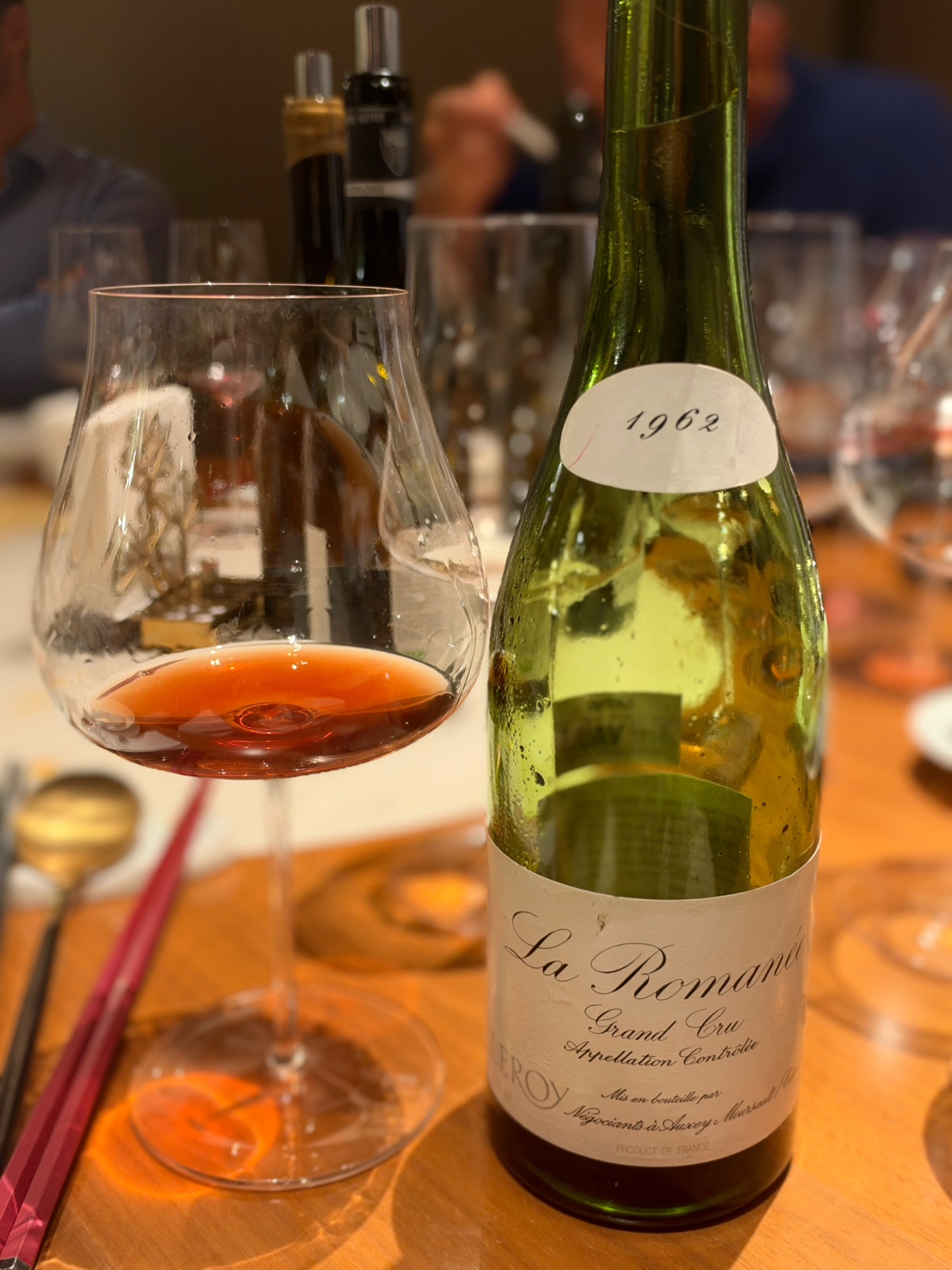
Leroy · La Romanée Grand Cru 1962 · Négociant Bottling · Served Blind
The blind finale revealed: Leroy's La Romanée of the 1962 vintage — neck label and main label in close-up, the wine a brick red earned over decades.
The Seventh Bottle · Leroy La Romanée 1962 (Blind)
The whole table tasted blind. I gave my answer first: a Maison Leroy négociant wine of the 1970s. The direction was entirely right — I had the house; I was one decade out on the vintage.
Then my friend Rudy Kurniawan spoke. Rudy is a master taster, and he gave the full name in one breath: 1962, Leroy, La Romanée. Vintage, house and vineyard — all three exact.
The First Blind Bottle — My Call
My call
1970s, Maison Leroy — the house right, the decade out
The First Blind Bottle — Rudy's Call
Rudy Kurniawan
1962, Leroy, La Romanée — vintage, house and vineyard, all three
When the bottle was revealed I read the label line by line: the neck label hand-written “1962”; the main label La Romanée Grand Cru; and the bottling line, bottled by Leroy, négociants at Auxey-Meursault. In 1962 there was no Domaine Leroy — it did not exist until decades later — so this could only be a négociant bottling. Every word he had spoken matched the label.
La Romanée covers just 0.85 hectares, one of the smallest grands crus in all Burgundy. To name that vineyard out of a glass of brick-red old wine takes more than knowledge — it takes a memory built over decades of drinking.
“The tertiary aromas came out slowly. Superbly kept — it drank like a wine of the eighties.”
The most moving part of this bottle was not the guessing; it was in the glass. This is a wine of the 1962 vintage, yet it drank like a wine of the eighties — decades younger than its years. Its tertiary aromas unfolded slowly, in no hurry at all, the bottle evidently kept in superb condition.
Looking back, my palate had not lied to me: the wine truly was younger than its vintage, and I simply had not dared to call the sixties. Rudy dared to say 1962 because he has drunk enough old wine to know exactly what a perfectly kept bottle of that era should taste like. That lesson was worth more than the wine itself.
A wine of 1962, still standing — and standing steadier than many a young wine. This glass was the finale of the night, and the one I most want to keep.
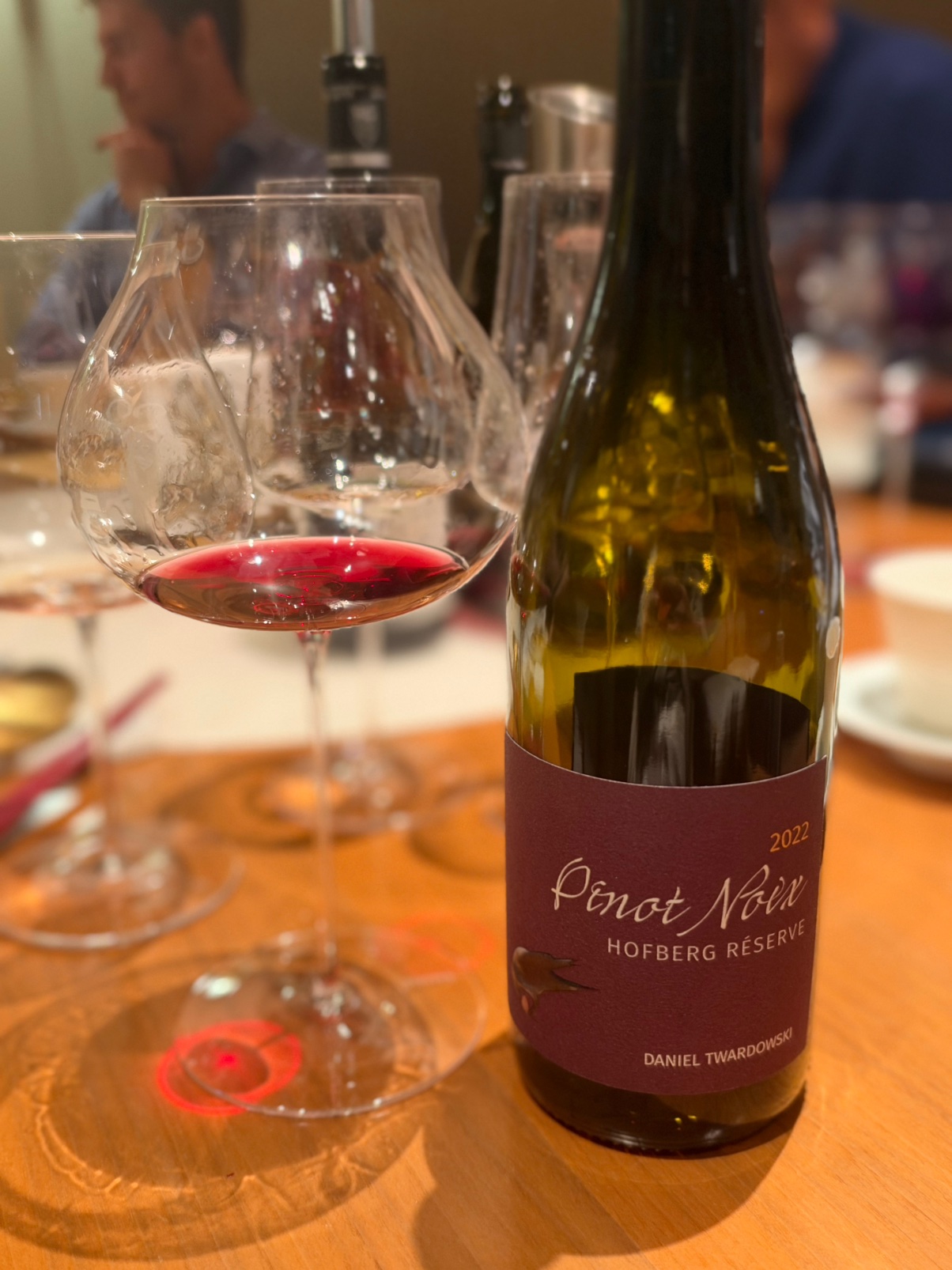
Daniel Twardowski · Pinot Noir Hofberg Réserve 2022 · Mosel, Germany · Served Blind
The second blind flight: Twardowski's Hofberg Réserve 2022 — the label in close-up, full frame.
The Eighth Bottle · Twardowski Hofberg Réserve 2022 (Blind)
The next blind bottle, and Rudy Kurniawan was exact again: grape, country and vintage — a German Pinot Noir, 2022.
The Second Blind Bottle — the Call
Rudy Kurniawan
Pinot Noir, Germany, 2022 — grape, country and vintage, all three
Revealed, the wine was Daniel Twardowski's Hofberg Réserve 2022, from the Mosel. The winemaker's day job is trading the great wines of Burgundy, and he makes Pinot Noir only; his vines were propagated from cuttings of Clos de la Roche, Richebourg and other famous vineyards, and his barrels are the used casks of DRC, Leroy and Rousseau. The Réserve is his top wine, from vines of forty to seventy years. No wonder this bottle is so easily mistaken for Burgundy — half of its bloodline and half of its craft are Burgundian.
To separate a German Pinot Noir from Burgundy, and still name the year: two blind bottles, two exact calls. Some wines are remembered for how they appeared as much as for how they tasted — and this one I record chiefly for the tasting itself.
V
The Table — Chang Zhen Wei, Where Good Food Carried Good Wine
A Private Kitchen · Causeway Bay
Chang Zhen Wei Chinese Cuisine · 10/F Cubus, 1 Hoi Ping Road, Causeway Bay
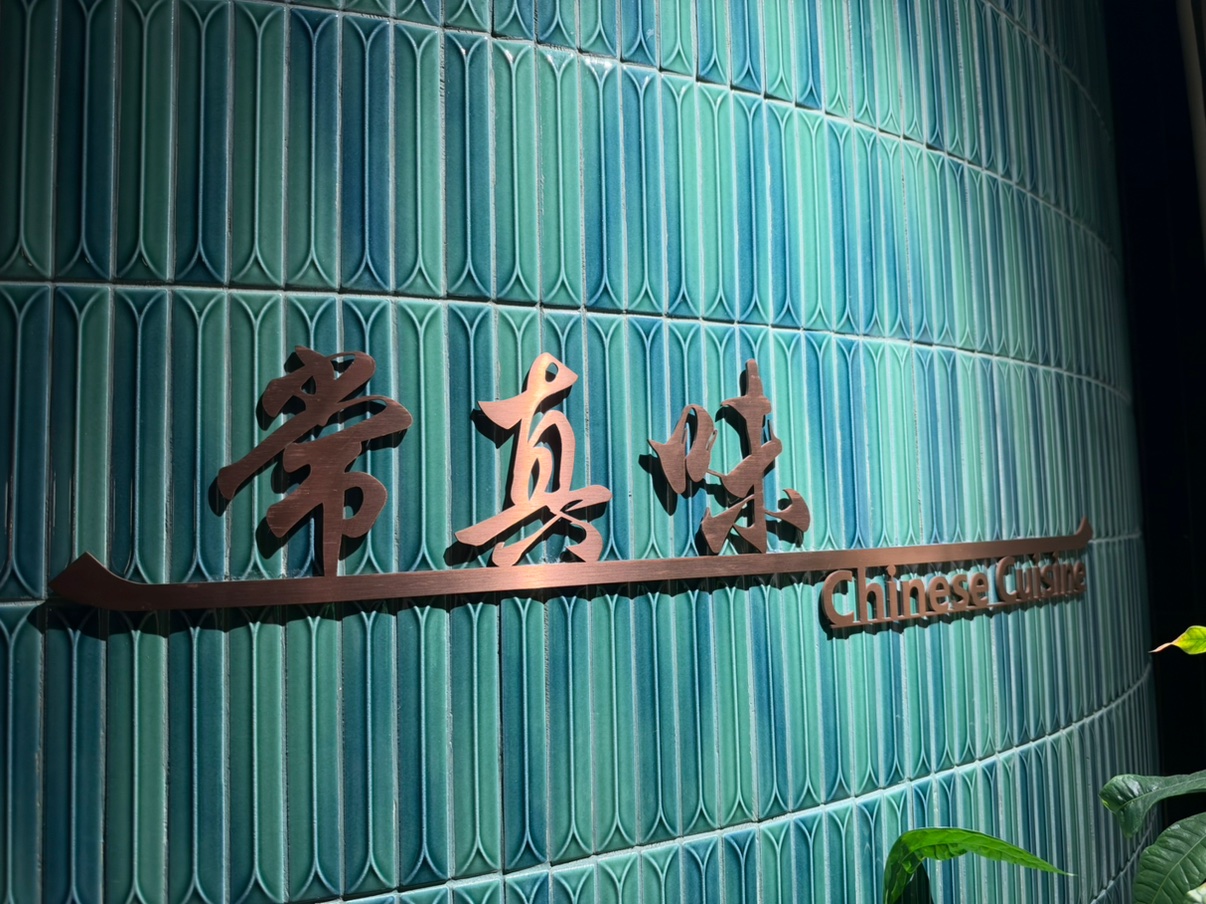
The storefront of Chang Zhen Wei, full frame: a turquoise-green tiled wall and a sign in copper characters.
The evening's table was set at Chang Zhen Wei. Its name comes from the Caigentan, the Ming-dynasty book of wisdom: “True flavour is plain; the true person is unadorned.” The restaurant opened in 2024 at Cubus in Causeway Bay, steered by Ding Yongzhang — “Young Master Ding” — with chef Yang Yinghong, a disciple of the celebrated chef Shao Delong, equally at home in Huaiyang and Cantonese cooking.
It does not trade on spectacle: three private rooms and three tables in the hall, privacy enough and a pace slow enough — nine bottles could be opened in comfort and tasted blind at leisure precisely because of this room. Nor is there a fixed menu: every morning the chef walks the market himself, chooses what the season offers, and only then writes the day's menu, which guests often receive just a day or two ahead.
It looks homely, and the craft underneath is deep. The dishes reviewers return to again and again include abalone crowned with crisped scallion; a crisp-skinned chicken in ginger and scallion oil that carries the proprietor's own name; and a steamed egg custard — “Lotus on Water” — steamed with the juices of seafood, a simple dish praised by everyone who writes about it. A Ming Pao review found the right words for the place: warm-hearted food, with the taste of home.
East Week reported in August this year, under a headline calling it “two years after opening, still one of the hardest tables to book,” that it is a dining room Jack Ma visits on every trip to Hong Kong. My own judgement on the night agreed with all of it: this is a very good restaurant — not for piling up costly ingredients, but for proportion. The food never fought the wine, and the wine never pressed on the food; nine bottles in, nobody at the table was tired. That is the greatest service a restaurant can do a wine dinner.
VI
The First Sitting's List · For the Record
Sitting One · Nine Bottles
2023
Jules Brochet, Le Massif (Chardonnay)
Fifty-year-old vines, 300 bottles a year; reductive sesame like the d'Auvenay whites, a mouthfeel close to a great white wine
2020
Jules Brochet, Mailly Grand Cru (Pinot Noir)
Les Champs aux Buissons, vines of 1965; bottle 500 of 521; full yeast character, balanced acidity, deep golden colour
1996
Domaine de la Grange des Pères, Blanc
Roussanne and Marsanne with Chardonnay; thirty years without oxidation, at its peak
2016
Coche-Dury, Meursault-Perrières
Opulent Chardonnay, full of flinty minerality
2023
Boigey Frères, Les Boudots 1er Cru
The first red; easy to drink, its layers still simple, red fruit in front
2023
Jean-Pierre Guyon, En Orveaux 1er Cru
Rose unfolding slowly, silken tannins
1962
Leroy, La Romanée Grand Cru (négociant bottling)
Served blind; a wine of the 1962 vintage whose tertiary aromas unfolded slowly — it drank like the eighties; Rudy Kurniawan named vintage, house and vineyard
2022
Daniel Twardowski, Hofberg Réserve
Served blind; a Mosel Pinot Noir — Rudy Kurniawan named grape, country and vintage
1990
Auguste Clape, Cornas (Magnum)
Far left in the line-up photograph; this magnum was carried on to the second sitting at Whale Club — its tasting note is in that chapter
VII
The Second Sitting — Whale Club, in Central
Whale Club · Central · The Second Sitting
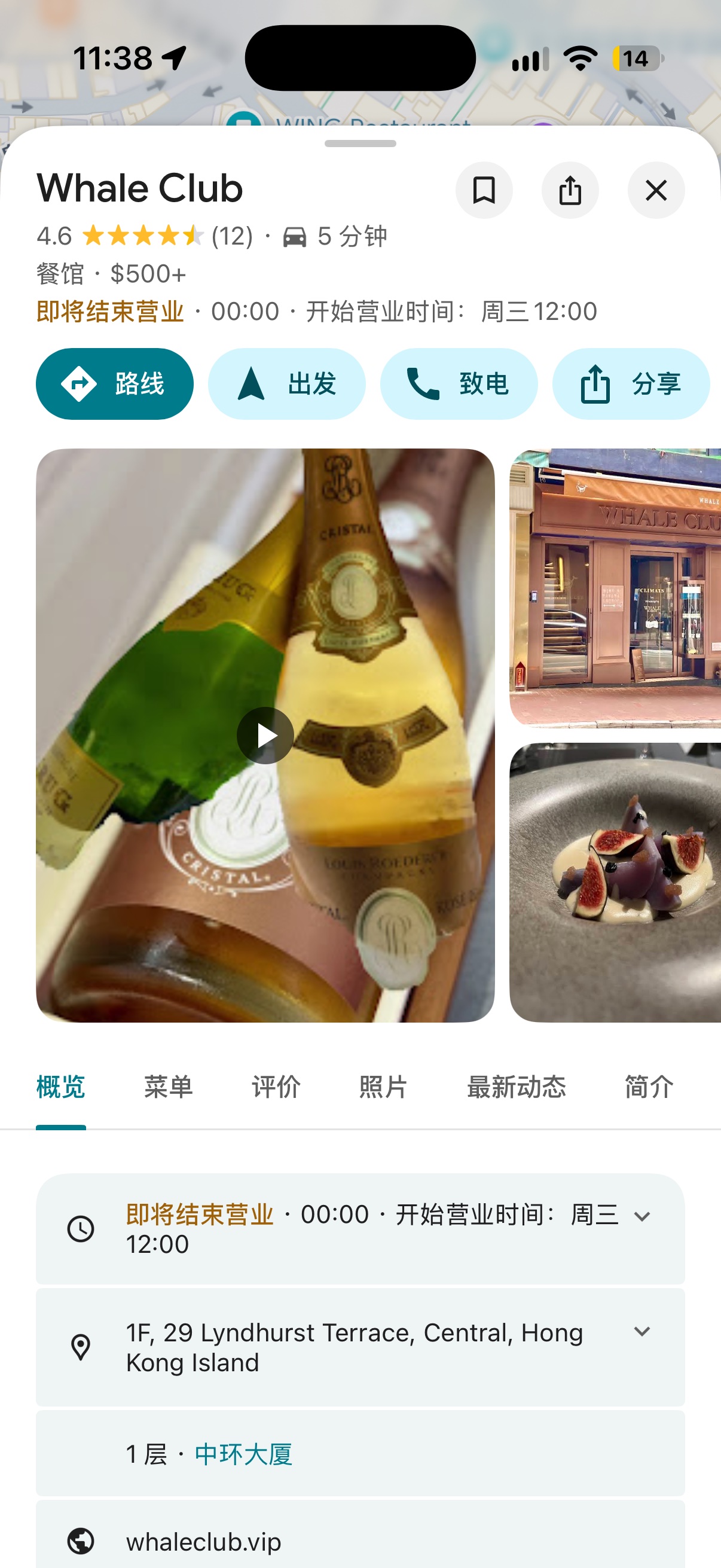
Whale Club · 1F, 29 Lyndhurst Terrace, Central, Hong Kong
Whale Club's map listing, shown in full: rated 4.6 (12 reviews), $500+, open until 00:00, at whaleclub.vip.
On to Central
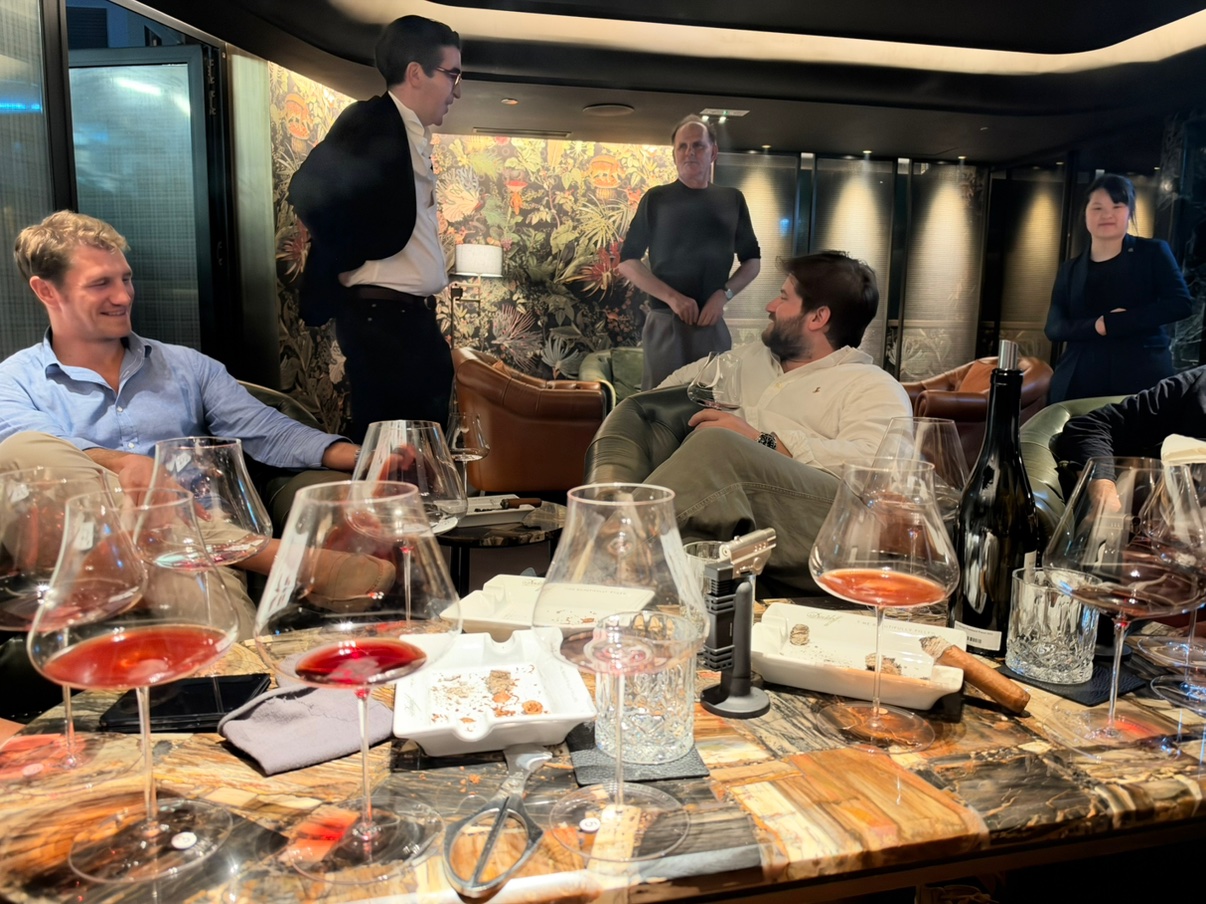
Chang Zhen Wei drew to a close, but the night was not over. We moved on to 1F, 29 Lyndhurst Terrace in Central — Whale Club.
In my view, it is the finest wine club in Hong Kong — without rival. Club Bâtard, over in the Pedder Building, is the more commercial of the two: its cellars hold a great many bottles, and in my view not a few of them are fake. Whale Club is different: the quality of its wines is genuinely assured, and the people who come here are true devotees of fine wine, who love to taste good bottles in this room. Those are my own words from the night — a personal view, set down as spoken.
Six bottles followed: a blind Australian Pinot Noir; the Cornas magnum carried over from the first sitting; a magnum of the “cleaver”; and three Burgundies revealed from the blind flight. They are written here in that order.
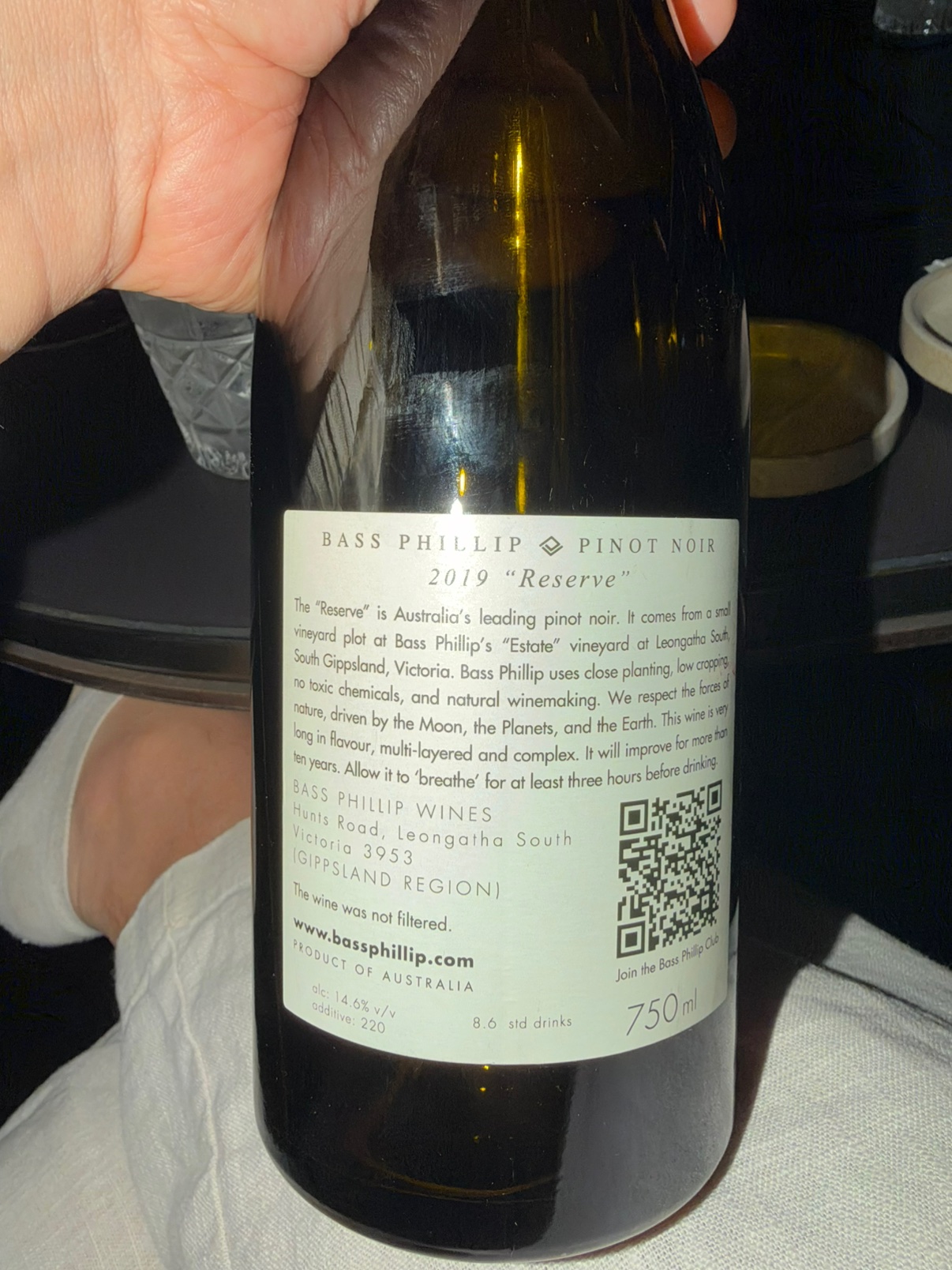
Bass Phillip · Reserve Pinot Noir 2019 · Gippsland, Australia · Served Blind
The back label, shown in full: Gippsland fruit, unfiltered — and, at the lower left, the 14.6% alcohol that was its only tell.
The Ninth Bottle · Bass Phillip Reserve 2019 (Blind)
The second sitting opened blind. The table guessed its way round the world — and no one named Australia. In the glass, it wore the face of Burgundy, completely.
Phillip Jones founded the estate in 1979, planting Cabernet Sauvignon first; then he fell for Henri Jayer and replanted to Pinot Noir — at Burgundian density, farmed biodynamically. The Reserve comes from just five rows of the original 1979 vines, some 1,500 bottles a year. In a blind tasting in 2011, it beat DRC.
2019 was a year of transition: in 2020 the estate was sold to the Burgundy proprietor Jean-Marie Fourrier; in 2019, Jones was still there for the harvest, and John Durham blended and bottled the wine. Huon Hooke scored it 98; Australian retail is around AUD $1,574. The one thing that gave it away was the alcohol — 14.6%, a number Burgundy's Pinot Noir rarely reaches.
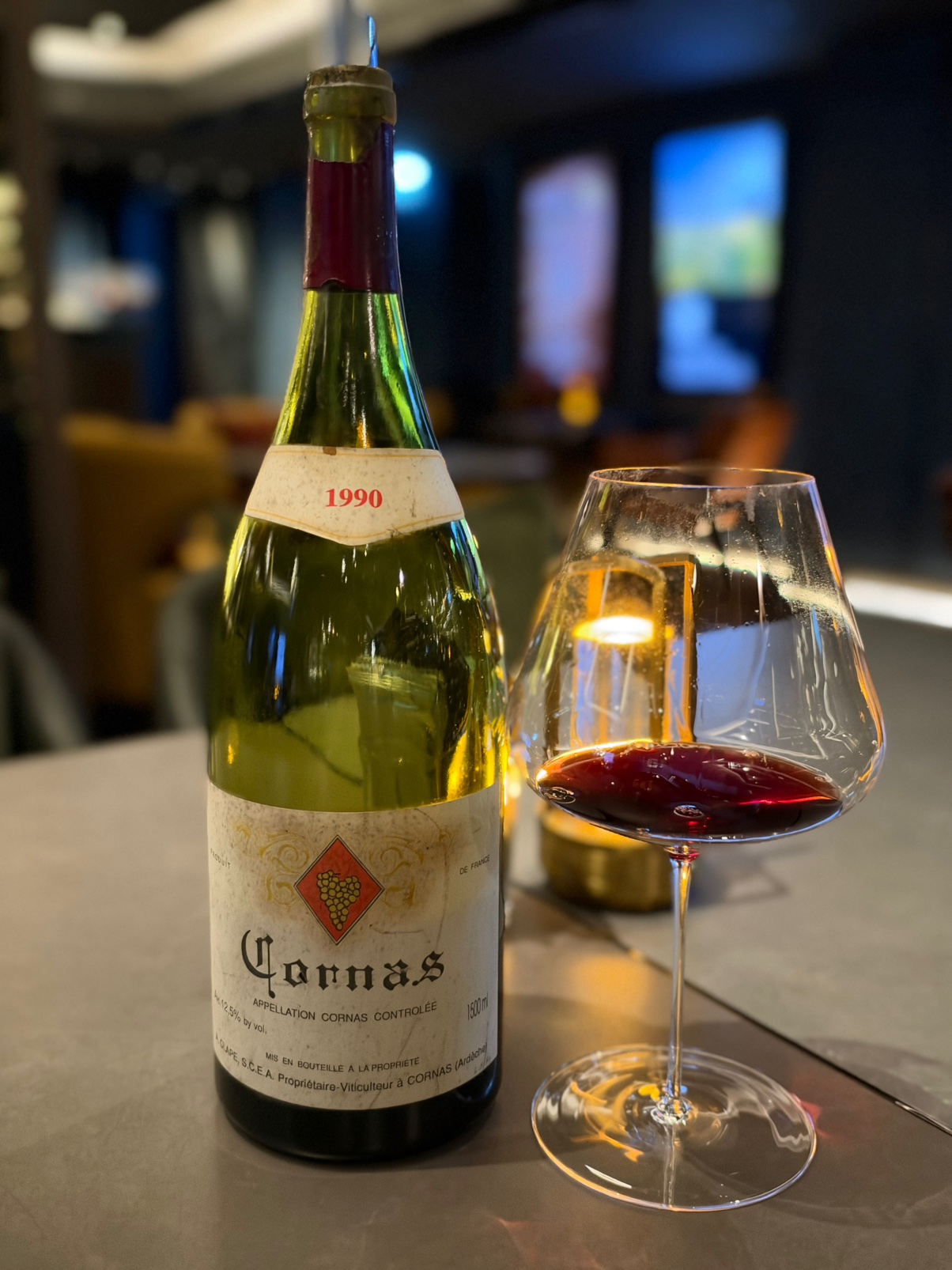
Auguste Clape · Cornas 1990 · Magnum, 1500ml · Carried Over from the First Sitting
The Cornas 1990 magnum at Whale Club, shown in full: the 1500ml on the main label is why it aged more slowly than a standard bottle.
The Tenth Bottle · Clape Cornas 1990 Magnum (Carried Over)
“This bottle was in superb condition too — the tertiary aromas in full. A magnum really does hold up far better than a 750ml.”
Those were my words on the night. This magnum had been opened at the first sitting and was carried to Whale Club to be finished — one bottle, two sittings. One hundred percent Syrah; Parker scored it 91.
A magnum at thirty-six years, squarely at its peak. One cork guarding twice the wine, it ages slowly: at an age when a 750ml bottle should be fading, the big bottle stood firm. The bottle at the far left of the first photograph was, in the second sitting, finally drunk in full.
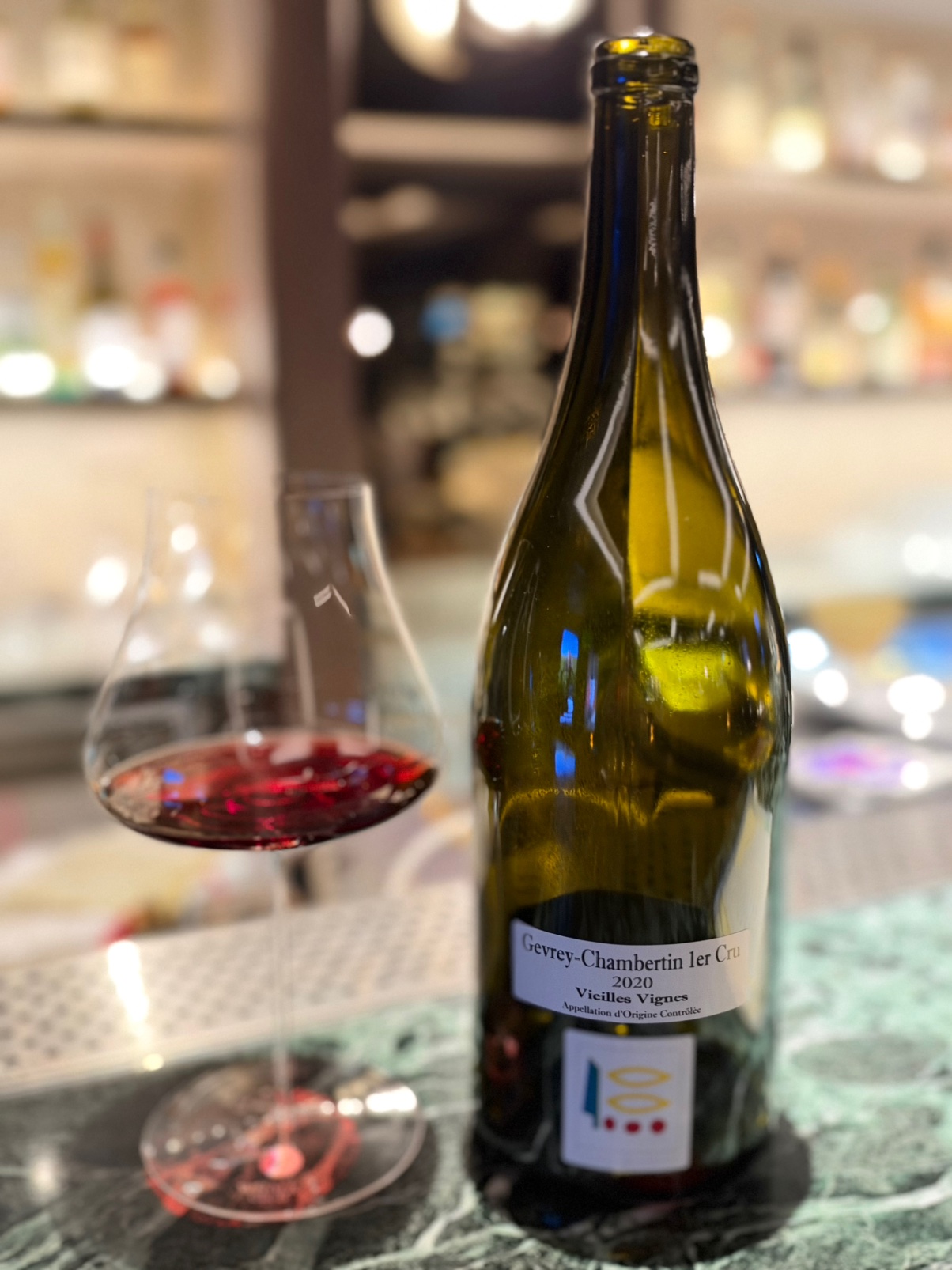
Domaine Prieuré Roch · Gevrey-Chambertin 1er Cru Vieilles Vignes 2020 · Magnum · The “Cleaver”
The “cleaver” 2020 magnum, shown in full: the emblem below the label, nicknamed a cleaver, is in fact a vine.
The Eleventh Bottle · Prieuré Roch Gevrey 2020 Magnum (The “Cleaver”)
“So aromatic — truly stunning!”
The emblem on the label is nicknamed a “cleaver” among drinkers; what it actually draws is a vine. Henri-Frédéric Roch founded the domaine in 1988 — co-director of DRC, and nephew of Lalou Bize-Leroy. As the saying goes among wine friends: to drink the “cleaver” is to drink DRC and Leroy at once.
Whole-cluster fermentation, no added sulphur, biodynamic farming. Vivino rates it 4.3, with a drinking window of 2025–2033. This magnum had only just entered its window, and already the aromatics were leaping from the glass.
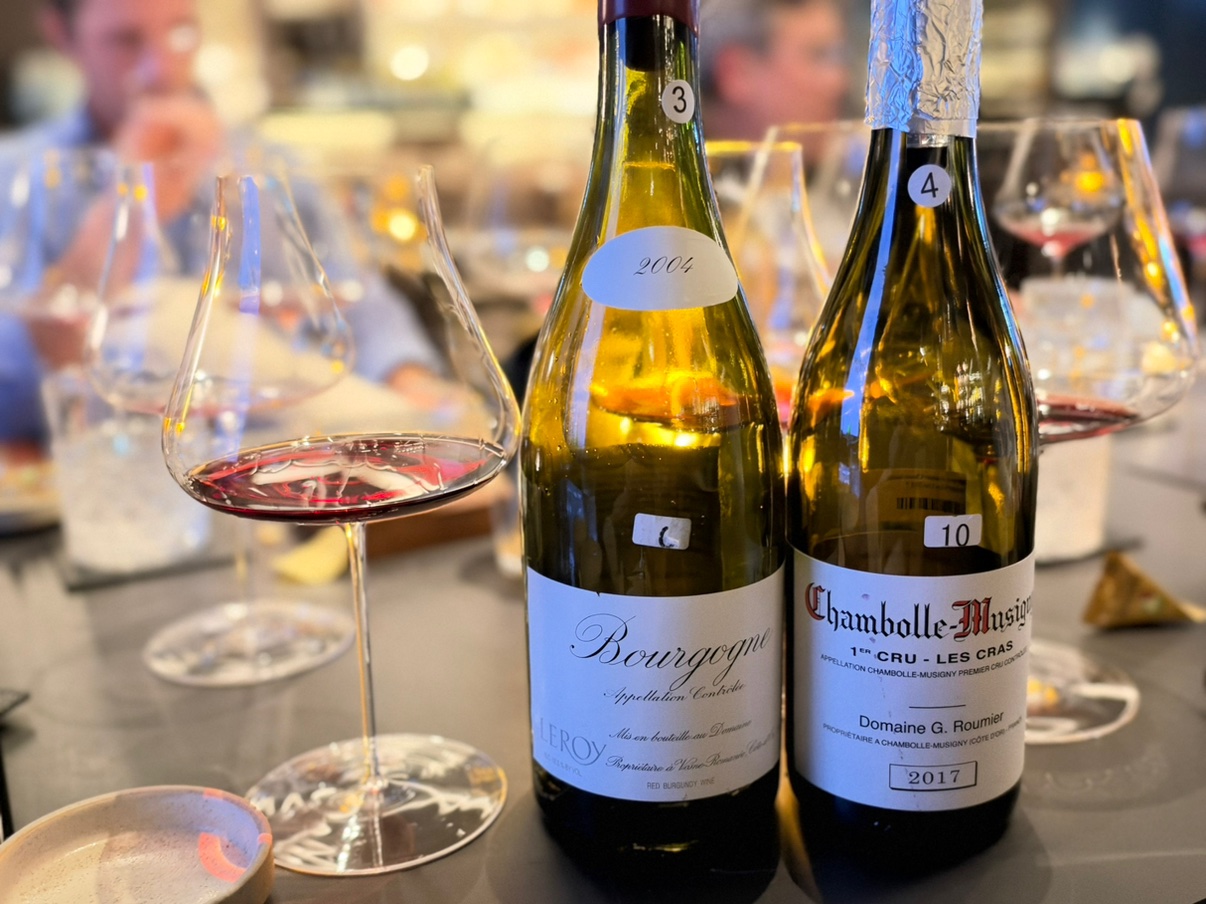
Blind bottles No. 3 and No. 4 in one frame, shown in full: the Leroy Bourgogne 2004 with neck tag “3” on the left, the Roumier Les Cras 2017 with tag “4” on the right. The fourth and fifth bottles share this photograph.
The Twelfth Bottle · Leroy Bourgogne 2004 (Blind No. 3)
The third blind bottle revealed was Domaine Leroy's regional Bourgogne. Do not be misled by the word Bourgogne: in 2004, Lalou Bize-Leroy declassified her entire vintage — inside this regional bottle is village-level, even premier cru, fruit.
Burghound scored it 92, calling it of “top premier cru quality”: red raspberry, spice, earth and violet. And 2004 was Burgundy's “ladybird vintage”, when many wines carried a green edge; Leroy's ruthless sorting kept it out. This bottle was only revealed that night — I left no tasting note, and the name alone is record enough.
Domaine Georges Roumier · Chambolle-Musigny 1er Cru Les Cras 2017 · Blind Bottle No. 4
The Thirteenth Bottle · Roumier Les Cras 2017 (Blind No. 4)
The fourth blind bottle is the right-hand bottle in the photograph above: Roumier's Chambolle premier cru Les Cras, 2017. Christophe Roumier is the benchmark of Chambolle-Musigny; Les Cras lies at the foot of the slope, beside the Clos de Vougeot.
Wine Spectator scored it 95: black cherry, blackcurrant and violet over a stony minerality, with a drinking window of 2023–2045 — squarely inside its window now. This bottle, too, was only revealed; I left no tasting note.
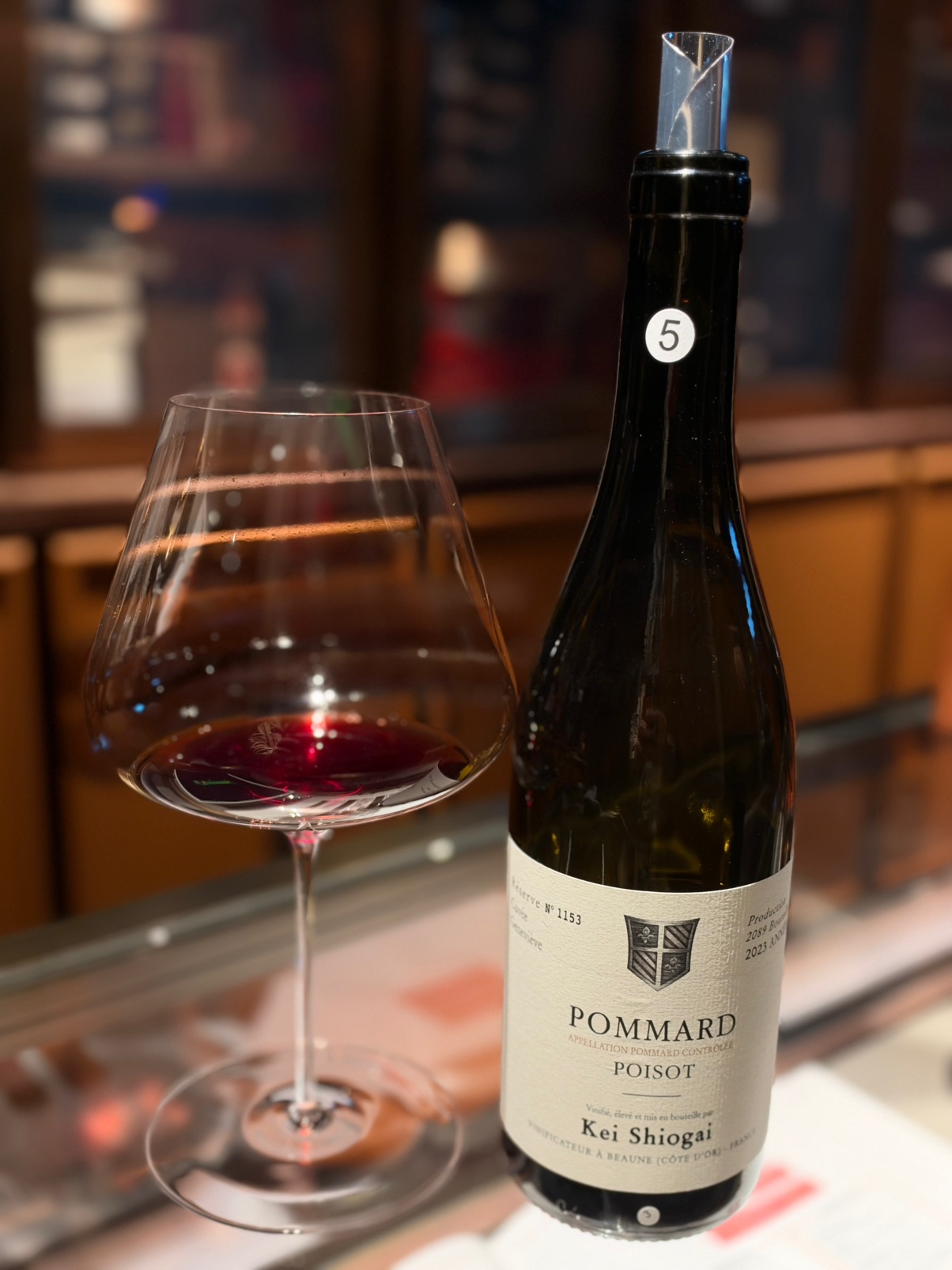
Blind bottle No. 5, shown in full: the “5” tag still on the neck; Réserve N° 1153 at the upper left of the label, and at the upper right the vintage's total production — 2,089 bottles.
The last blind bottle revealed was the work of a Japanese winemaker in Beaune. Kei Shiogai began as a sommelier in Tokyo, came to France in 2013, and studied winemaking in Beaune and Dijon, working at Philippe Pacalet (from 2014), Domaine Armand Rousseau (2019) and Domaine Jean-Marc Roulot (2020). He founded his own label in 2020, with the first releases in 2021. Some ten thousand bottles a year across sixteen cuvées, whole-cluster and low-intervention — production is tiny, allocations fiercely tight: one of the hardest Beaune micro-négociants to buy today.
Poisot is a lieu-dit in Pommard. The 2023 vintage ran to just 2,089 bottles; this one is Réserve N° 1153. Greg Sherwood MW scored it 94+, calling it “an iron fist in a velvet glove”: blackberry, black cherry, strawberry and savoury blackcurrant, over graphite and limestone minerality, with a drinking window of 2026–2038+. It trades around CHF 390 at Swiss retail, and about $634 at auction.
This bottle, too, was only revealed that night; I left no tasting note. The name and its story are record enough — it was the last bottle of the evening.
And with that, the second sitting was done: fourteen bottles, one night, closed out in Central.
The room at Whale Club
Fourteen bottles, drunk, are empty bottles. What remains is this record, page by page: which bottle recalled the d'Auvenay whites; which wine of the 1962 vintage still drank like the eighties; which bottle a friend named to the very year, out of a single glass — and which Australian Pinot Noir fooled an entire table of blind tasters at the second sitting. Years from now, I hope I can still recall that flash of gold as a glass was raised to the light, the sudden quiet around the table when the blind bottle was revealed, and the Cornas carried from Causeway Bay to Central to be finished at the last.
Good wine passes. Good condition is rare. This evening is written down, to be kept.
Colophon — Written on the night of 17 November 2026. Nine bottles at the first sitting, Chang Zhen Wei; six at the second, Whale Club — with the Cornas 1990 magnum counted once across both, fourteen bottles in all. All tasting notes are my own words from the evening, recorded on the spot; the Leroy Bourgogne 2004, the Roumier Les Cras 2017 and the Kei Shiogai Pommard “Poisot” 2023 were only revealed that night and carry no tasting note here, so only their names and backgrounds are recorded. Le Massif is of 2023 (label lot RMS23). The Chang Zhen Wei section was checked against OpenRice, the Ming Pao review and East Week's August 2026 report, and the dishes named are those of published reviews, not a record of what was served that night; the Whale Club section rests on its map listing and my own words from the night, and the comparison between the two clubs is a personal view. All photographs were taken on the night and are shown here in full, uncropped.